

Posted on July 30, 2026
NIGHT HEAD synopsis – episodes 4 & 5
trigger warnings: childhood sexual abuse, suicide
Episode 4 – Awakenings
broadcast date: october 29th 1992
Director: Masato Hijikata (土方政人)
Screenplay: George Iida (飯田讓治)
Naoto Kirihara – Etsushi Toyokawa (豊川悦司)
Naoya Kirihara – Shinji Takeda (武田真治)
additional cast can be viewed here
We open on the lads driving through an affluent neighborhood, though the tense music underscores the eerie atmosphere – these two are here to look for the childhood home they lost 15 years ago, and they’re not sure what they’ll find. Naoto seems keen to move forward, but Naoya is anxious and unsure. They sit in the car a while, reminiscing – yet memories of the night they were taken away screaming keep flooding back. Naoya wonders where their parents are – “Mikuriya says they’re not in Japan anymore”, his brother reminds him. And yet, Naoya remains unsure.
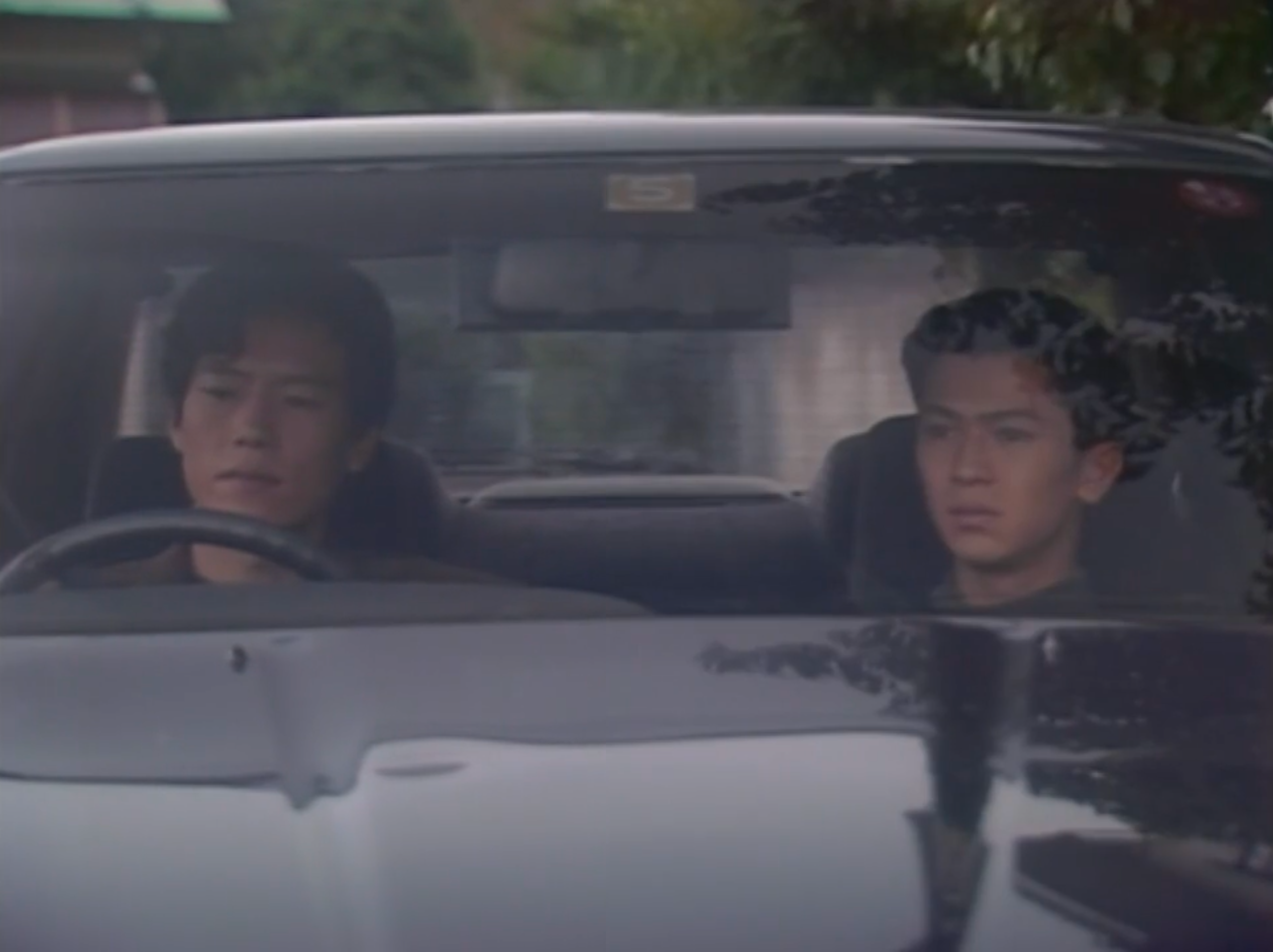
Grimacing, Naoya poses this question to Naoto: “If ‘that’ hadn’t happened, do you think we could have stayed at home a little longer?” His older brother pauses, saying that perhaps that could have been the trigger, but that it was ultimately inevitable. “We already knew that we were different from ordinary people before then.” Naoto pushes for them to get going, but Naoya says he can’t yet – he senses something, and it scares him.
We flash back to the brothers still living with their parents. Their mother and father are having a spirited conversation at home with some distant relatives, the Hanaokas, a married couple and their teen daughter. Masuo Hanaoka, a man around their father’s age, laughs and says he’s surprised Naoto is only in the fifth grade – around 10 years old1 – given how tall he is. He had taken him for a high schooler!
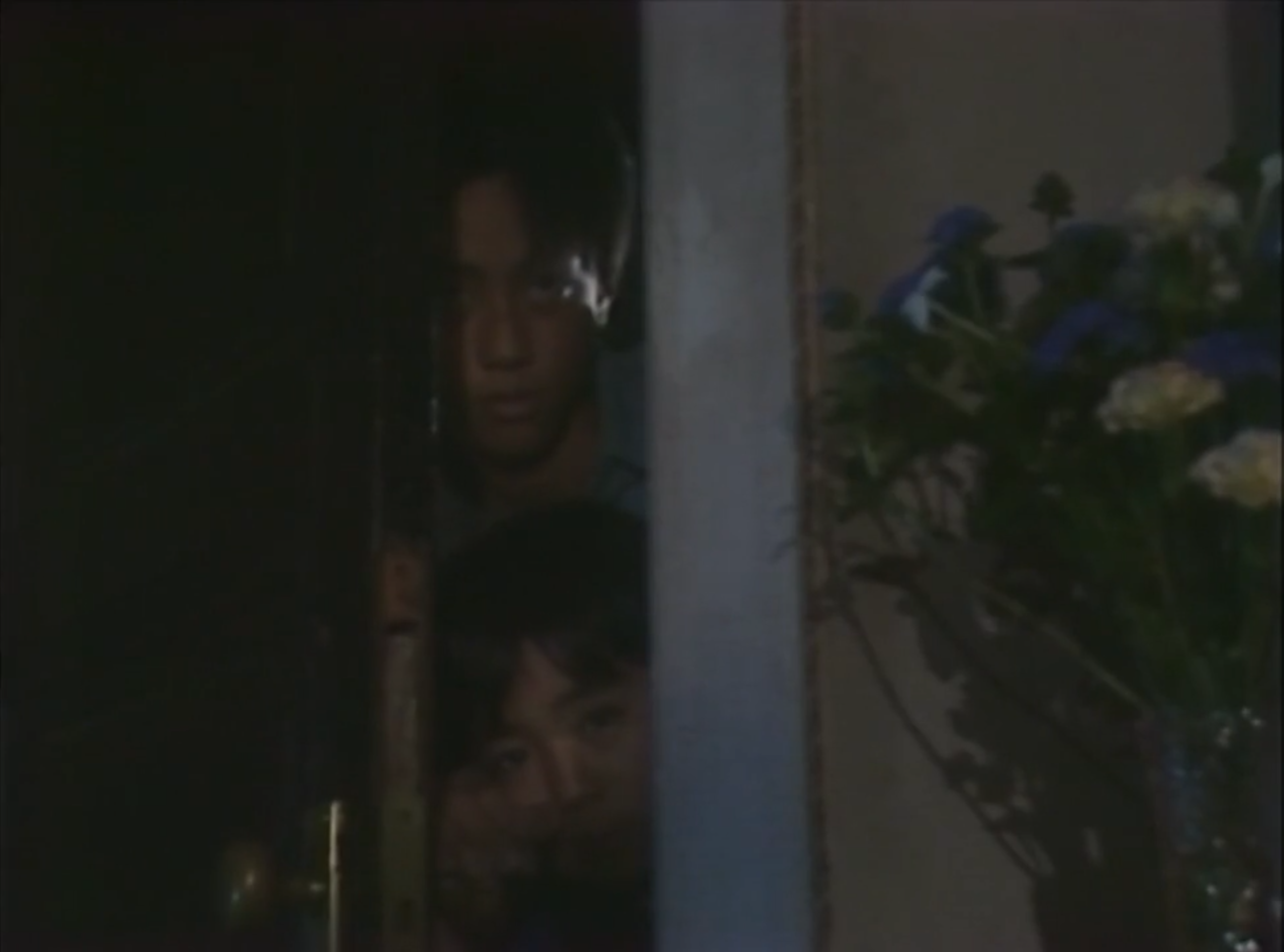
He apologizes for suggesting Naoto might be a good marriage match for his 17-year-old daughter Sanae, and they all have a good laugh. Sanae spots the two young brothers peeking at the group through the living room door, and ever so politely says she’d like to go spend some time with them. Graciously she departs, and the adults begin to discuss Masuo’s offer to purchase some land.
Once she leaves the adults, Sanae drops all pretense – she lopes into the room smoking, and when Naoto tells her not to use his pencil case as an ashtray, she burns his hand. But things go beyond run of the mill bullying at this point – after showing a disturbing level of interest in what his burnt hand looks like, Sanae then proceeds to fellate Naoto’s hand in a way I can really only describe as sexual assault. Naoto’s powers come to the fore here not in protecting himself, but to protect his younger brother – when Sanae tries to reach for him next, Naoto’s psychic powers snap, pushing her away. In the present, Naoto recalls that this was the first time he had ever injured someone.
Their recollection of events was that their powers were born in trying to protect their parents from a bad business deal – that the Hanaokas were trying to scam them, and if the deal had gone through it would have bankrupted both their family and their father’s business. However, it’s worth noting that in the past, Naoto first tried to tell his parents that Sanae was a bad person – and they didn’t believe him. When he speaks up, his parents assume that he must have done something wrong to her first, and then suggest that Naoya (age 51) must have “said something strange” to have upset her, and that Naoto shouldn’t go around making accusations like that. So, well before the brothers understood that their parents were being scammed, alarm bells went off because their parents thought Sanae was nice, and didn’t notice – or believe – that she was hurting them. The birth of their psychic powers came about because of the required escalation at not being believed – because now they needed to see and understand more than their parents did, so that they could be the ones to protect themselves as well as their parents.
They describe the birth of their powers like so:
Naoya: “I used to see things sometimes – glimpses of people – but it was always vague. I never saw them clearly. But when I saw those relatives… I felt a strange, deep unease. Watching mom and dad smiling and talking with them was scary at first, but before long, I found myself desperate to know who those people really were … Before then, I only had a vague sense of things but after, everything became crystal clear. What others have done and what they’re thinking.”
Naoto: “Up until then you’d been unconsciously rejecting that ability – but at that moment you wished for it. I was the same. That was when I wanted to do something … Anger was welling up inside me. From then on, whenever I felt anger, things around me would start to break.”
We have a brief recollection of a time when they were given a strange gift by the Hanaoka family: a large clown doll, which they both dislike. In the original script, this is described as “nearly life-sized”, which would be a pretty unusual gift to receive (let alone prop to produce.)3

What transpires after this is that – as the Hanaoka family attempt to move forward with their scam – the lads utilize their newfound powers to intervene on their parents’ behalf, ‘reading’ the ill-intent of the Hanaokas through touch, and preventing them from leaving with all the explosive, ham-fisted violence you’d expect from a 10-year-old.
Naoto recalls that, “after that, it was hell” – he was banned from school, while Naoya was hospitalized – a year later, they were taken in by Mikuriya. What sticks out in their memory, however, was that clown doll. Naoto remembers its eyes being extra disturbing, Naoya agrees, and they laugh, wondering where the Hanaokas could have bought such a scary toy. In passing, Naoya says he thought its red eyes were particularly spooky – and Naoto, confused, asks him what he meant. Red eyes? The eyes were blue. No, red – Naoya is sure. They go back and forth on this, both absolutely certain of what they remember, but eventually drop the issue. While Naoto finally presses forward to look for their house, Naoya momentarily seems perturbed, thinking on the disconnect between their memories.
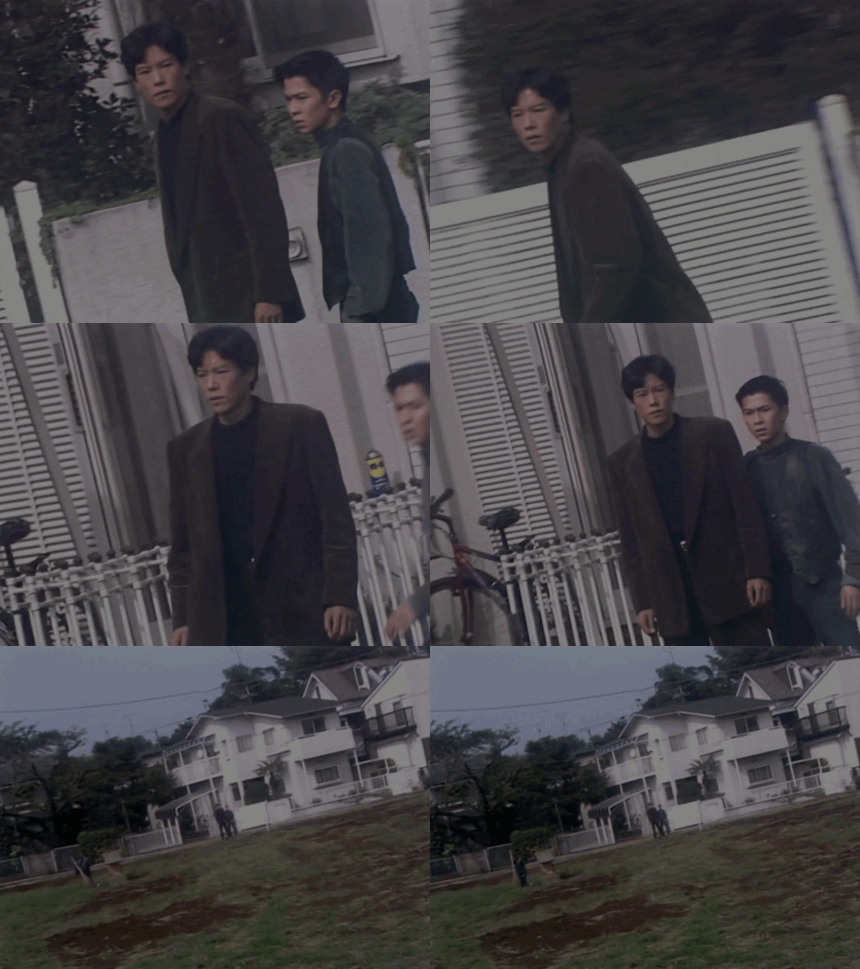
As they head out, their search for the house becomes increasingly frantic, only to end up at an empty lot with a small shrine. They approach an elderly woman, asking when the house was torn down, only for her to react in confusion: there hasn’t been a house here as long as she’s been alive… At that moment, the mysterious Shoko appears, briefly, before disappearing again.
A car horn honks, and they turn to see a young woman who they recognize, and call out her name: Mariko. She’s someone familiar from Mikuriya’s research lab, perhaps his secretary, and she’s politely cross with them for not appearing here sooner after escaping from the facility. She says that she’s been waiting here, since she knew they’d come eventually. Naoto becomes increasingly distraught, demanding answers: what about their home, parents, memories? Is any of it real? Mariko says she has a message to pass on from Mikuriya: “Find the answer for yourselves.” Naoto, in shock, asks if that’s all. To this, she says no – handing them a thick envelope full of money, “for living expenses.”4 In stunned silence, she tells them she needs to get going, and asks them to keep in touch – and that no one is trying to get in their way. But Naoto is still fired up, demanding to know if their memories were implanted by Mikuriya – and if so, what is their real past? Bluntly, she repeats Mikuriya’s message: “find the answer for yourselves,” before driving off – leaving them in the road, staring after her.
———————————————
With this watch, the entire crux of the episode – two men, revisiting a traumatic site from their childhood – takes on an entirely different nuance, for me. It has both the textual understanding, as the birthplace of their psychic powers and subsequent institutionalization, but also of the implicit sexual violence of their older relative. Naoya’s later trepidation can be read as both psychic foreshadowing, as well as just straight up PTSD. I especially feel for Naoto, given that his seeming “maturity” in looking older could have led others to feel justified in pushing him further than he was capable or willing – or for people to not believe him, as we saw later with his parents. An older female relative who manages to slip under the radar, taking advantage of two younger boys with threats of violence? Even if this was their only encounter, it does go some way towards explaining the pair’s mutual discomfort around sexually aggressive women throughout the show.
This episode was a tough watch, and I really feel for the lads. A four year old forced to read social situations beyond his years, learning to intuit danger to be able to avoid it, and his 10-year-old brother doing his best to protect him physically, boiling with rage… It’s interesting to think about the root of their powers in the context of this trauma. What George has presented us with is trauma that birthed “power” (in terms of psychic abilities), but while still understanding the limitations and difficulties they bring (much like PTSD). These powers are both a strength and a weakness, and the clarity with which this is linked to their trauma is both tragic and, for the time the show aired, refreshing.
Episode 5 – Victims
broadcast date: November 5th 1992
Director: Katsuyuki Motohiro (本広克行)
Screenplay: George Iida (飯田讓治)
We begin this episode with a distraught young woman, walking the streets barefoot in the early morning. Her inner voice cries out, despairingly – why does she need to keep living? We then see her lying in the grass along a riverbank, bleeding out, having slit her wrists.
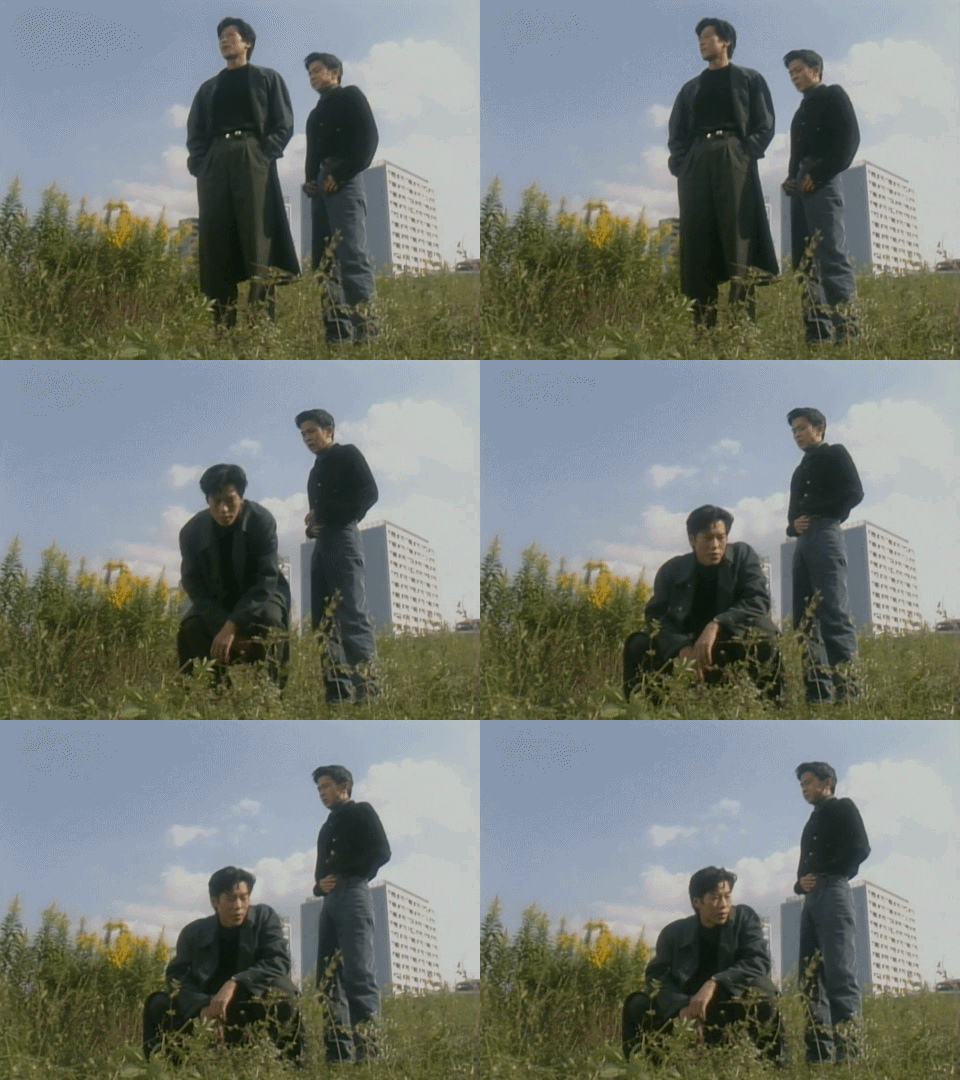
We next see the lads walking along that same riverbank – Naoto points out where the suicide occurred, and asks if they should go take a look. Naoya says sure, but he is already visibly distressed. Naoto, completely unfazed, crouches to look closer while Naoya looks like he’s going to barf. Over the last month, five teens have killed themselves in the same area and by the same method. Naoya sees a flashback to the body of a victim, the girl from before – he notices she’s wearing a crystal necklace, but is then so overwhelmed that they have to leave.
As they walk away, Naoya wonders aloud why Mikuriya would ask them to investigate this case – and why his brother would be willing to help, given his hatred of the researcher who held them captive. His older brother stops abruptly, snapping – “five people are already dead. More might die, too. If it’s possible to stop it, we should.”
Relenting, the two do some more research on the details of the case – apparently, the teens were all part of the same friend group. But it’s also revealed that this isn’t the first string of suicides – three years before, the same thing happened with slightly different circumstances. At this, Naoya wonders if the cause is spiritual – whether the ghost of the first person to die might be luring the others in. He seems unnerved by this, revealing some limits to their powers – “If that’s the cause, then there’s nothing we can do about it”. But if that’s the case, Naoto responds, “that means Mikuriya thinks it’s something else”.
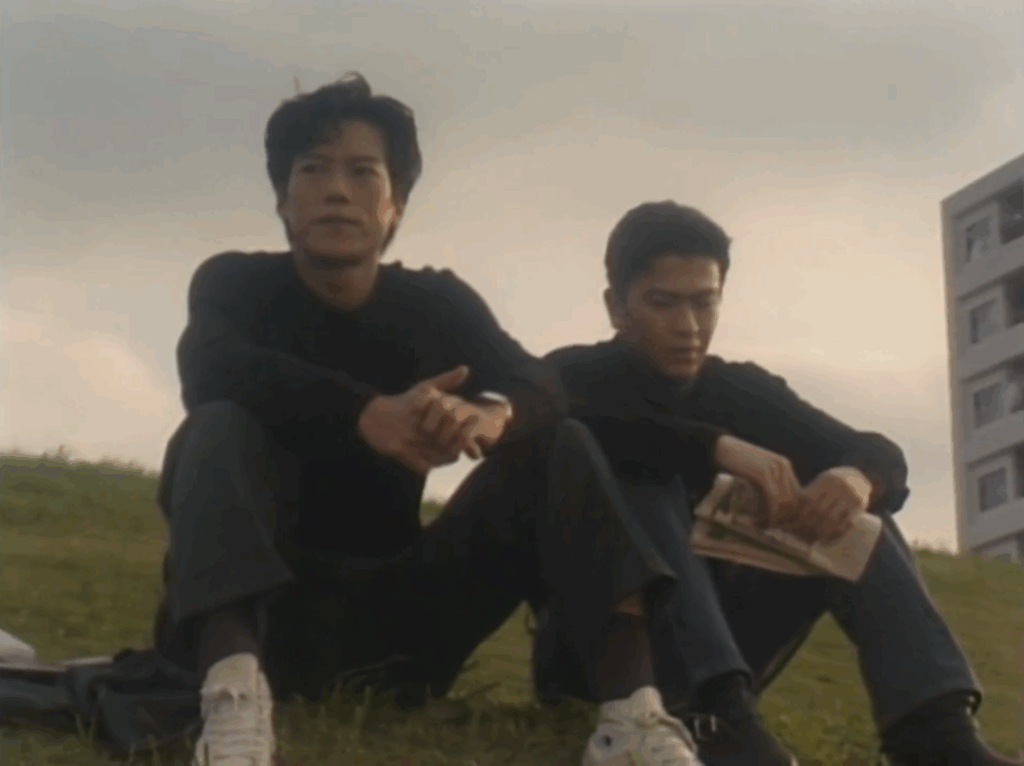
We cut to a group of glum teens in an abandoned warehouse, discussing the deaths of their friends and their trepidation at what might happen to themselves. Certain things indicate some level of delinquency – dyed hair, pompadours, smoking – but they seem genuinely confused about why their friends have been dropping like flies, wondering if it was really suicide at all. One girl in particular (Yoshimi) insists that Megumi, their friend who died most recently, would never kill herself. But at the very least, they begin to realize that at this rate, another among them will die soon enough.
As the teens part ways, we see Yoshimi be approached by our very own Kirihara brothers. Naoya whispers anxiously that she’s the friend of the girl who died, and Naoto approaches her. In the end, though, he’s equally awkward – flustered and stuttering, she responds that they’re weird and walks away. Naoya turns and shouts after her – “aren’t you wearing a crystal necklace? A match to Megumi’s?”
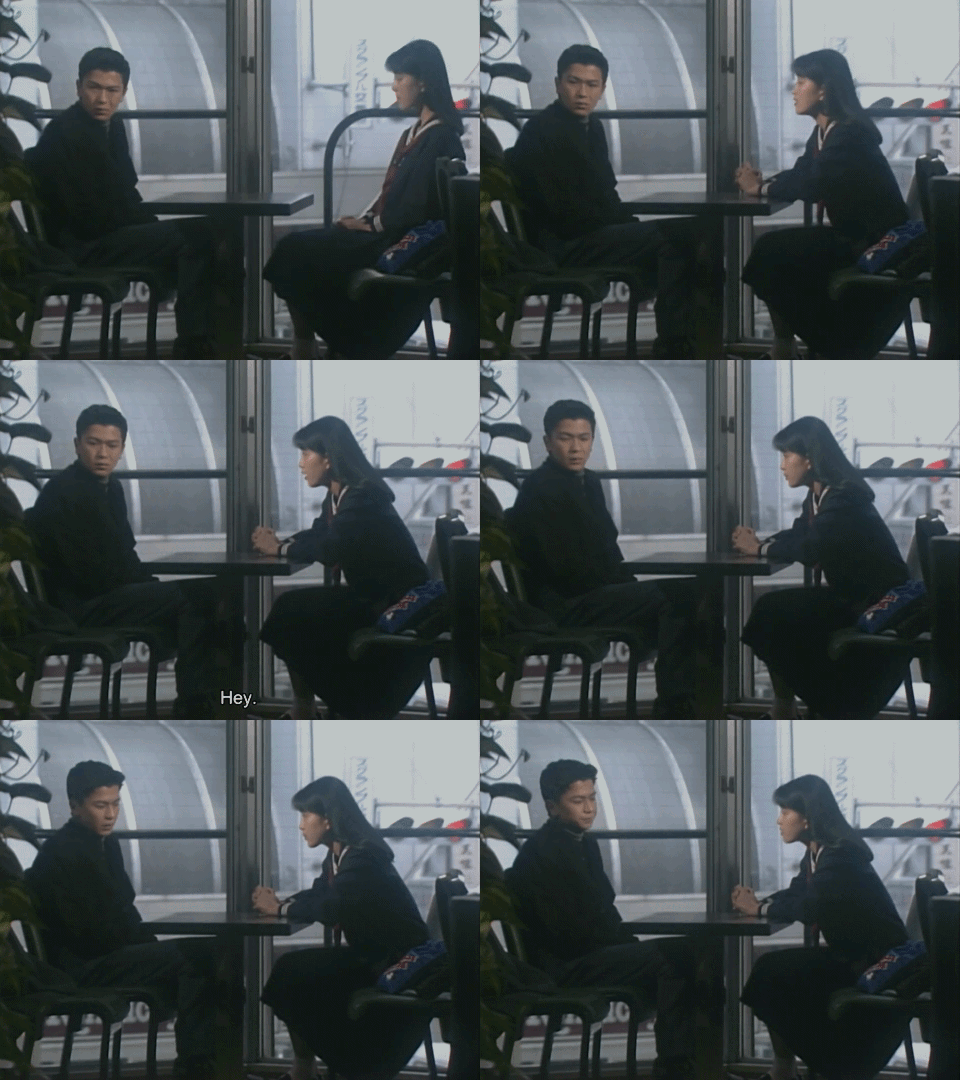
This apparently convinces her to go to a fast food place with them – while Naoto is off ordering food, Naoya and Yoshimi are left alone, much to his chagrin, and when she tries to talk to him about the necklaces, he visibly recoils. On Naoto’s return they discuss her sadness about her friends while pressing her for more information – Naoto in particular wants to know if there’d been anyone strange in their lives that might have had an impact. When she wonders what he means, he explains by telling an anecdote about Picasso having rotten vibes – it’s actually too odd for me to summarize, so I’ll include the whole thing here:
“In Picasso’s life, there were at least three people who committed suicide and two who went insane. It’s believed that knowing Picasso was the cause. Everyone emits something like radio waves from their brain. [denpa] There are all sorts of these—some people radiate frequencies that make others feel happy, while others give off ones that make people feel unpleasant. Picasso is an extreme example of this; he was a genius, but he also possessed those negative traits.”
Ironically, of course, she finds this so off-putting that she ends up leaving, telling them that they’re the weird ones. She doesn’t even eat her burger! They both seem confused and upset at this, but I can’t say I blame her – I love these freaks, but it doesn’t seem like a great move to take a bereaved teen girl out for lunch only to talk over her grief with crackpot theories. Naoya seems overwhelmed as she leaves – Naoto, crestfallen, pats his younger brother on the back.
We move to Yoshimi’s bedroom, where she looks at a photo album of all her friends, flashes of Megumi bringing her to tears. She sobs, and begs to know why Megumi would kill herself. Gradually, a quiet voice begins to encourage her to do the same – Yoshimi turns, and sees what appears to be the ghosts of her friends crowded in the corner of her room, proffering their wrists. “Give up the painful things, give up the sad things – just give up.”
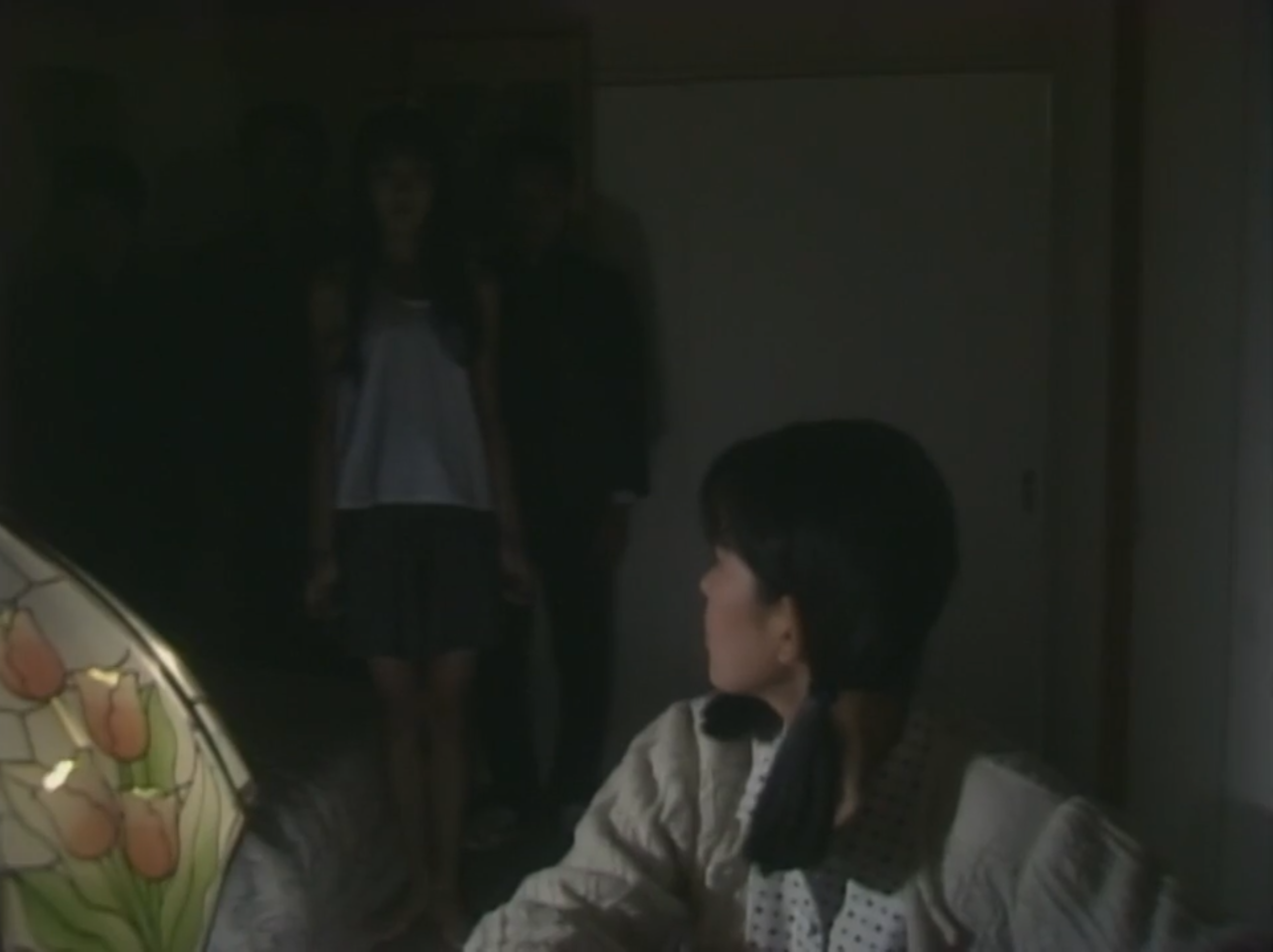
The brothers, asleep in their car outside her house, awake with a start. A pajama-clad Yoshimi is seen staggering out of her house, box-cutter in hand, and the lads rush forward to try and break her out of her reverie. Naoya, shocked, cries out – “this is mind control” – but they don’t know where from.
While the lads may have saved Yoshimi, another boy from the group was not so lucky. We see his body down by the riverside before cutting to the panicked remains of their gang, back at the warehouse. Yoshimi and the brothers turn up, and they press them all for more information – a dead-end interrogation, as they all still claim they have no clue why this might be happening. “It would be a lie to say I haven’t done anything wrong, but I just can’t remember anything that would get me killed” says one boy, when Naoya senses a psychic presence. He rushes off, trying to find the source – “They’ve been watching us all along,” he says, before hearing from the killer – “’They should just die – why do you keep getting in the way?’” Naoto asks if he got a feel for what kind of person they were, but no – just that they were angry and ready for a fight.
They decide to stick around at the warehouse with the teens to protect them, which devolves into madness as the night goes on. The three remaining friends begin crying and screaming, smashing bottles and attempting to kill themselves – the lads are barely able to fend them off before rushing out to track down the psychic source. They hurriedly make their way to a normal-looking apartment building, where they bust in on a confused housewife. She demands to know who they are, and they try and push past to the person Naoya senses, just in the other room. The woman and he briefly touch, only to stagger him. Shocked, he stares at her – “You knew all along. You knew, yet you just let it happen.” At this assertion, the woman collapses in tears, and the lads rush past to open the door on –
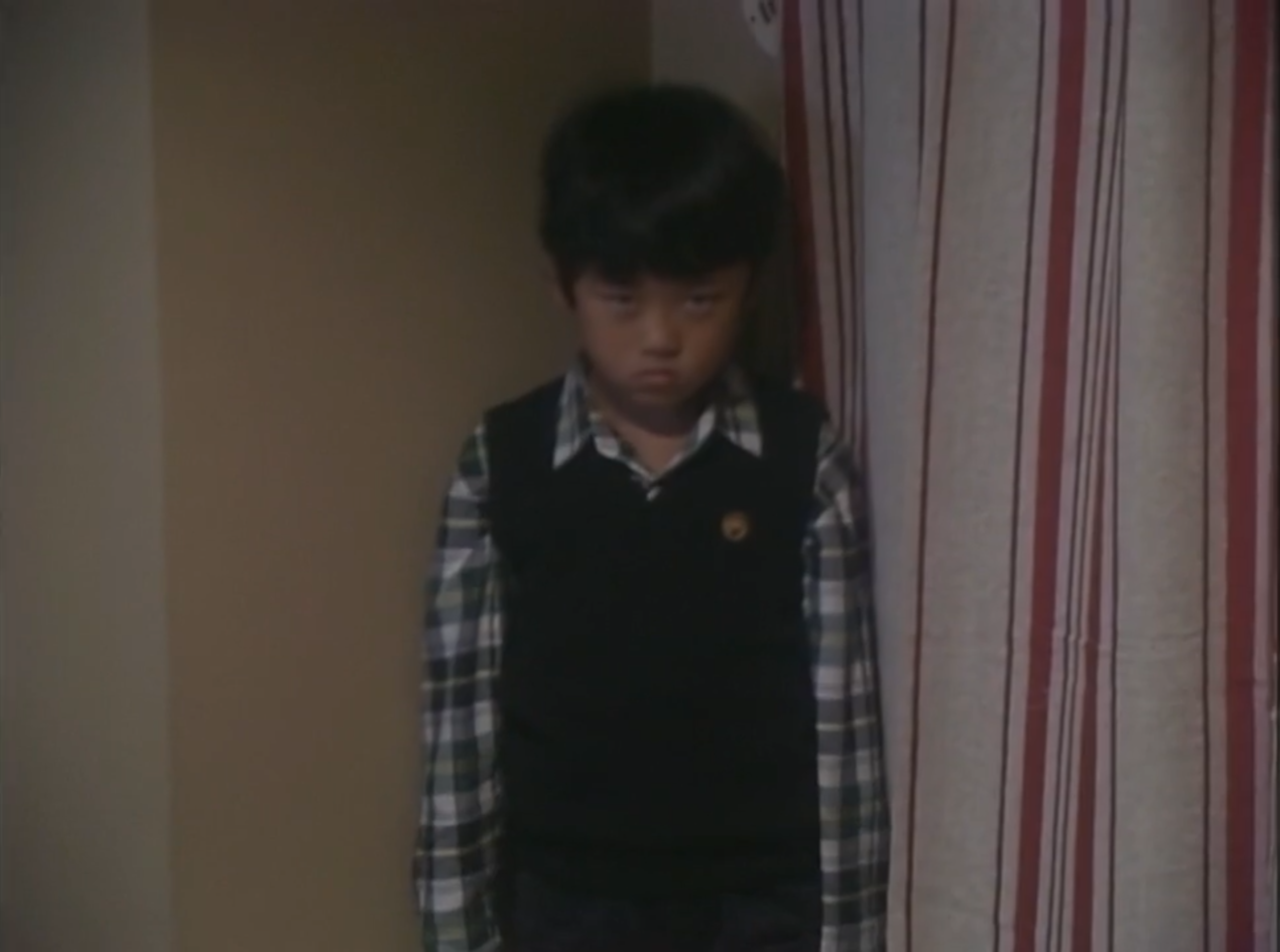
A young boy, standing in the corner of his room. “It was you”, says Naoto – the boy, Masayuki, yells back – “Those guys killed my dog!” We come to learn that the gang of teens had at some point run over Masayuki’s dog and left it to die. He had been using his psychic powers in retaliation, convincing them to kill themselves. Masayuki’s mother rushes in, begging them to leave well enough alone – that she’ll make sure he stops, but it’s not like the law could punish him anyway. Naoto asks if he was also responsible for the previous string of suicides several years ago, to which Masayuki interjects – “Yeah! I got rid of the bad guys!”
The sight of this grade-schooler evokes images of themselves at the same age, as they were taken away screaming in desolation. And yet, for the first time, this memory actually prompts Naoto to reach out to Mikuriya – because he’s the only person who could take Masayuki in. Masayuki’s mother is distressed at this, insisting that he is her child and they can’t take him away – that he hasn’t done anything illegal. With a look of pity, Naoto asks her, “Surely you don’t want him to kill anyone else. What he’s doing is clearly murder.” At this, she quiets down, her face crumpling as she falls to the floor – “But they were trash… It wouldn’t matter if they were gone…”
Naoto turns to his younger brother – “I hate Mikuriya. But right now, he’s the only one who can accept someone with this kind of power.” As Masayuki’s mother begs them not to take her boy away, Naoya is wracked with memories of their own traumatic departure. He approaches Masayuki with a face contorted by sadness, kneeling to hug him – “Anyone might wish someone else was dead at some point, right? It’s something any human being might feel.” Naoto lays a hand on his shoulder, saying it’s time to go – but as he rises, they spot a photograph. The two brothers stare at it in shock – it shows Masayuki with Shoko, the girl who disappeared.
———————————————
Two pretty heavy episodes in a row! There’s a few things worth noting. We’re starting to see more rules and types of psychic powers introduced – for one thing, they apparently can’t impact ghosts! We also have the introduction of mind control, or at least, some kind of ‘influence’, since he still had to convince people to do something. I wonder if Naoto’s decision to call in Mikuriya was prompted by Masayuki’s mom’s lack of remorse at his actions – because with something like mind control, he could have been influencing them to reform rather than die. Seeing how she reacted so strongly to understandings of ‘illegality’, what’s ‘against the law’, or what can or cannot be punished, it’s sad to think that Masayuki only understood how to mete out the death penalty. Is it murder to convince someone else to kill themselves with psychic influence? Conversely, if you used psychic powers to influence someone to change for the better, would it be true reform?5
It’s interesting to note the parallels with the brothers’ own childhood, and how Naoto’s decision to have this kid removed from his home – a choice he wouldn’t have made for himself, or his brother – is influenced by the moral and ethical values he was taught by the very man who he hates, repeating the pattern. With these two episodes, we’re starting to see Naoto’s opinion of Mikuriya shift, which is interesting to see, especially without knowing more about him or their relationship. It’s nice to have a full 20 or so episodes for things like that to have room to breathe!
We’re also starting to see some of George’s New Age mysticism show up, with all the talk about crystals. I’m not one for that sort of thing personally, but I think what bothers me more is that George doesn’t bother to explain it in a compelling way, assuming that the real-world understanding is good enough – since enough people understand it to be real as-is. I’m an anthropologist by trade, so I can keep an open mind about most systems of belief without needing to be truly ‘convinced’ – but here, I don’t really feel like he’s done a good enough job of expanding on ‘crystal energy’ to make me even think it seems cool let alone real.
Similarly, I said above that Naoto’s Picasso monologue was full of crackpot theories – this is because of his specifically mentioning denpa, and how Yoshimi reacts. Naoto tends to be the ‘exposition’ character for all the worldbuilding with this kind of stuff, so it’s likely this is actually being presented to us (the audience) as reasonable, but it would seem confusing and unreasonable to Yoshimi since she doesn’t know their background. So, Picasso-style denpa may well come up again as a canonical psychic factor, which wouldn’t surprise me! Separately, Naoto not knowing what could be off-putting in a conversation like that is part of his gap-crush charm, and it’s nice to see that he struggles as much as his brother in his own way.
- In his book George Iida Talks about NIGHT HEAD, it’s stated that Naoto is 27 and Naoya is 20. While they were at Mikuriya’s research lab for 15 years, this scene in the past occurs a year before he took them away – if Naoto is in the 5th grade, this would make him either 10 or 11, depending on his birthday. Naoya is described as being in kindergarten still, so 4 makes the most sense. I opted for 5 and 10 in the above writing because it felt less presumptuous (given context), but I suspect they are 5 and 11. ↩︎
- In his book George Iida Talks about NIGHT HEAD, it’s stated that Naoto is 27 and Naoya is 20. While they were at Mikuriya’s research lab for 15 years, this scene in the past occurs a year before he took them away – if Naoto is in the 5th grade, this would make him either 10 or 11, depending on his birthday. Naoya is described as being in kindergarten still, so 4 makes the most sense. I opted for 5 and 10 in the above writing because it felt less presumptuous (given context), but I suspect they are 5 and 11. ↩︎
- I can’t help wondering where George thought he would get a clown doll that large! ↩︎
- How they got by without money was one of my initial questions – this feels like a cop out, but I’ll let it slide, since I enjoy seeing their odd little journey. Stories about psychics often end up solving this problem by having them cheat at roulette, or poker – it’s a trope I don’t enjoy, so this is preferable. (…Wouldn’t it be fun to see them get part time jobs, though?) ↩︎
- Just me thinking aloud, but – while this kid went for his own notion of retributive justice, I wonder what restorative justice could look like, with psychic powers. Since the latter relies on a dialogue between offenders and victims – yet these teens were convinced they did nothing wrong – perhaps some kind of emotional force-feedback where they had to directly “feel” the impact of their actions could help? Or are our subjective experiences of crimes too skewed? Ah, the joys of speculative fiction! ↩︎




Recent Comments