

about me!
hi, I’m mina! so, you want to know about me? well, not much to tell, however saying that I’ll probably go on and on about really irrelevant stuff – 需要がないとか気にしない. I don’t update much other social media since it makes my head hurt! please enjoy yr time browsing my little slice of cyberspace :^)
I hope that I have not tried your patience too much, and I thank you very much for the attention you have so kindly given to my fancies.
well, that’s me. thanks for stopping by. take care.
- “What made you go and work on the land?’ – I have so frequently been asked the question that perhaps an answer should be attempted. When a reason is completely obvious to oneself it is often difficult to explain it. Since ‘because I very much wanted to’ will not serve, I must be more explicit.”
– john stewart collis, the worm forgives the plough
- “In treating of the general problems of culture one is constantly obliged to undertake predatory incursions into provinces not sufficiently explored by the raider himself. To fill in all the gaps in my knowledge beforehand was out of the question for me. I had to write now, or not at all. And I wanted to write.”
– johan huizinga, homo ludens
- “But for this stimulus to discovery, who knows but that they would still remain unknown? On such slender threads of chance does much new research hang.” – i.d. margary, roman ways in the weald
- ‘Do you mean to tell me you’ve walked all the way here?’
I nodded. Shaking his head sadly, he said: ‘Then all I can say is it’s a pity you couldn’t be doing something useful.’
… For me the question wasn’t whether it could be done, but whether I could do it.”
– john hillaby, journey through britain
- “but the intellectual revolt which I have to speak to you about was even in its first days founded on an appreciation of the value of history … a laborious and patient sifting of truth from hearsay: the story of the past … we begin to see why we are placed as we are at present, and whitherward we are tending; and thenceforward we have not ventured to divide history into what is worthy and worthless to know of; men we are, and all that men have done or been is worthy of our thought”
– william morris, unpublished lectures
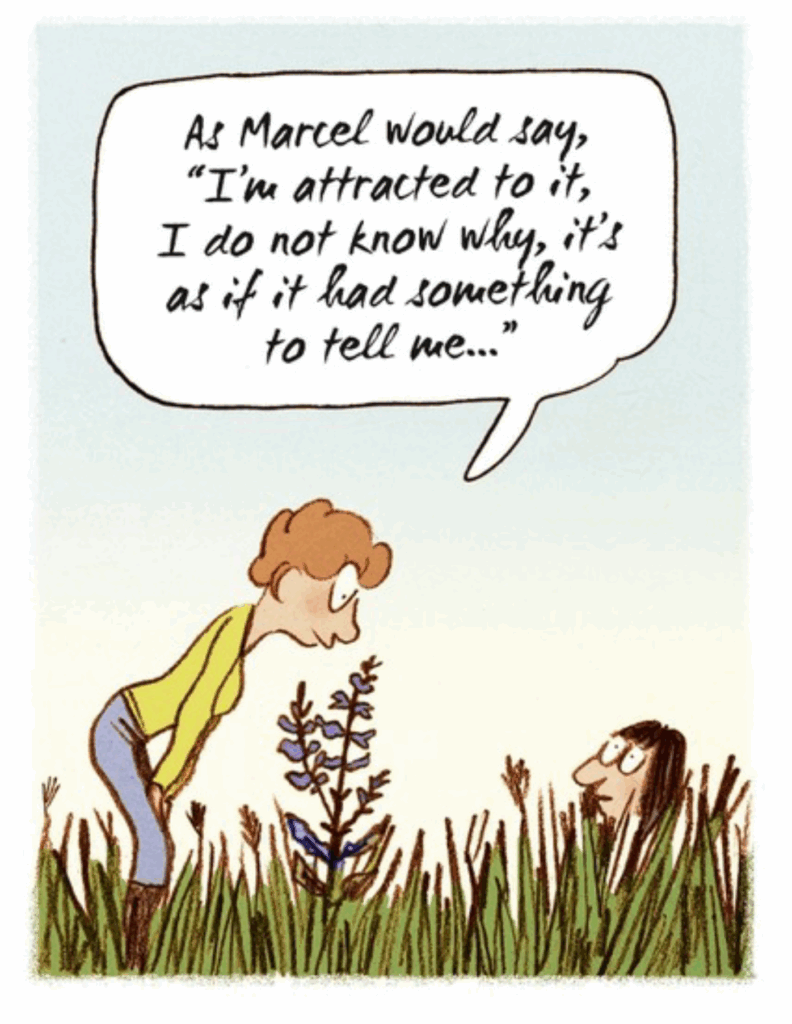
- In “The Carrier Bag Theory of Fiction,” Ursula K. Le Guin … proposes that storytelling might pick up diverse things of meaning and value and gather them together, like a forager rather than a hunter waiting for the big kill. In this kind of storytelling, stories should never end, but rather lead to further stories. In the intellectual woodlands I have been trying to encourage, adventures lead to more adventures, and treasures lead to further treasures … But Le Guin says it with so much humor and spirit that I give her the last word:
If it is a human thing to do to put something you want, because it’s useful, edible, or beautiful, into a bag, or a basket, or a bit of rolled bark or leaf, or a net woven of your own hair, or what have you, and then take it home with you, home being another, larger kind of pouch or bag, a container for people, and then later you take it out and eat it or share it or store it up for winter in a solider container or put it in the medicine bundle or the shrine or the museum, the holy place, the area that contains what is sacred, and then next day you probably do much the same again-if to do that is human, if that’s what it takes, then I am a human being after all. Fully, freely, gladly, for the first time.
– anna lowenhaupt tsing, the mushroom at the end of the world (citing ursula k. le guin, dancing at the edge of the world)
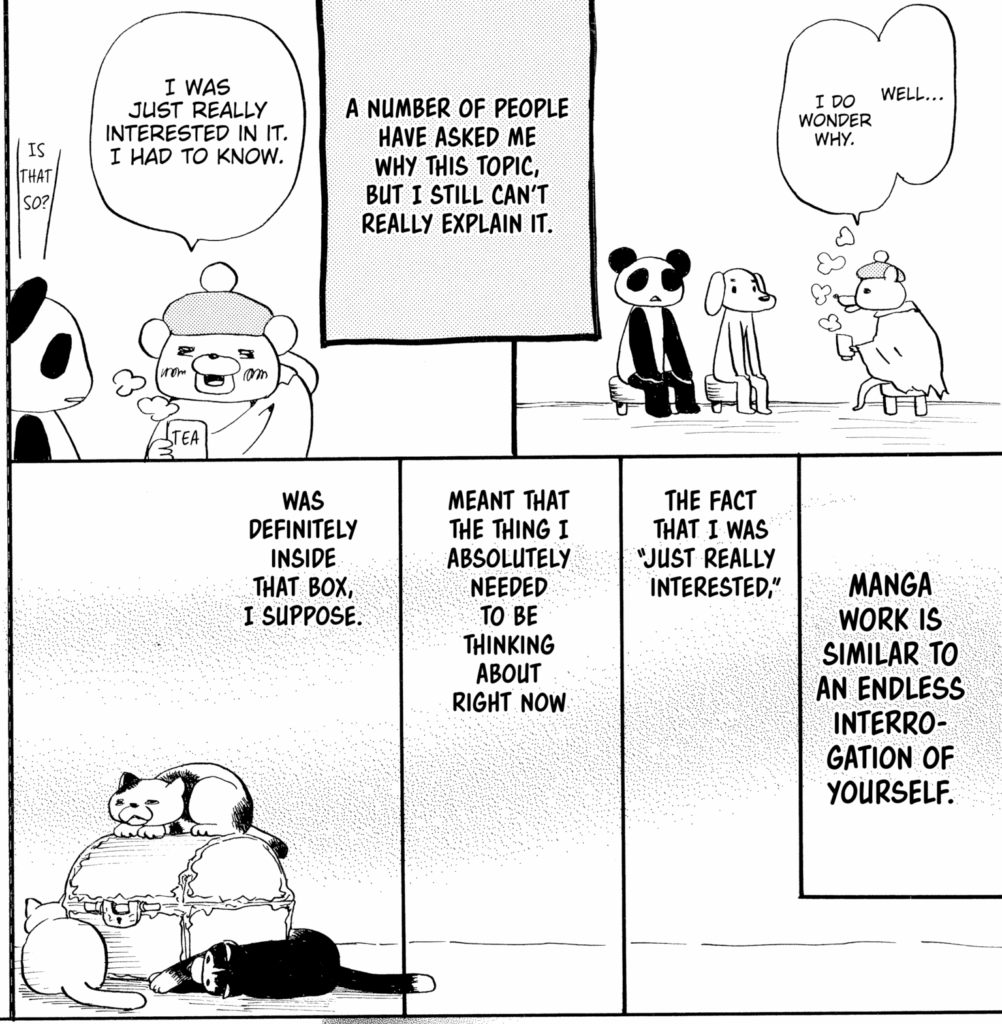
– umino chica, author’s notes to vol. 1 of march comes in like a lion
(read right to left)
- “poetry isn’t the outcome of personality. I mean by that that it exists independently of your mind, your habits, your feelings, and everything that goes to make up your personality. The poetic emotion’s impersonal: the Greeks were quite right when they called it inspiration. Therefore, what you’re like personally doesn’t matter a twopenny damn: all that matters is whether you’ve a good receiving-set for the poetic waves. Poetry’s a visitation, coming and going at its own sweet will.”
“Well, then, what’s it like?”
“As a matter of fact, I can’t explain it properly because I don’t understand it properly, and I hope I never shall. But it certainly isn’t a question of oh-look-at-the-pretty-roses or oh-how-miserable-l-feel-today. If it were, there’d be forty million poets in England at present. It’s a curious passive sensation. Some people say it’s as if you’ve noticed something for the first time, but I think it’s more as if the thing in question had noticed you for the first time. You feel as if the rose or whatever it is were shining at you. Invariably after the first moment the phrase occurs to you to describe it; and when that’s happened, you snap out of it: all your personality comes rushing back, and you write … according to the kind of person you happen to be. That’s up to you.”
– edmund crispin, the moving toyshop
- “Talent and all that are really for the most part just baloney. Any schoolboy with a little aptitude can perhaps draw better than I; but what he lacks in most cases is that tenacious desire to make it reality, that obstinate gnashing of teeth and saying, ‘Although I know it can’t be done, I want to do it anyway'”
– MC Escher, letter to his son Arthur, 1955



Recent Comments