

Posted on December 1, 2025
the curious medievalism of redwall
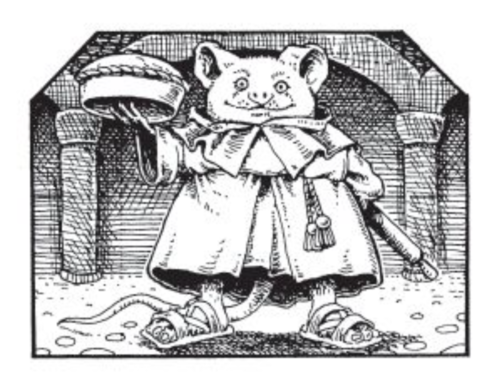
“What want you here, young beast, young beast,
What want you here at my feast, my feast?”
“O stripedog, great guardian, some food for us all,
For we are good young ones who live at Redwall!”
as december is thus upon us, I now begin the second year of what I believe I can officially call a ‘tradition’, started just last year – listening to all of Brian Jacques’s Redwall series in chronological order.
I had previously gotten as far as Mariel of Redwall, the 4th in the series, and have just started on the 5th, Salamandastron. but those numbers are somewhat deceiving – by internal chronology (rather than publication date), those would be the 6th and 8th books. while at times repetitive, the first four in the series did manage to differentiate themselves from each other quite well:
the first (or, 9th), eponymously titled ‘Redwall’ follows novice monk Matthias as he learns about the legend of Martin the Warrior who protects the abbey, and whose mantle he takes up. I was particularly taken with the ways Matthias must explore the abbey, climbing to dangerous extremes on the roof and introducing the sparrow tribes who live there and hold him captive.
the second book (or 3rd), Mossflower, takes us back to the past with Martin the warrior himself, before the abbey as we know it was formed. at this point, the echoing repetition of the voice actors and character tropes was revelatory – hearing the resonance between Matthias and Martin, particularly their hopes and fears in protecting their friends and community, helped to dispel the near saintlike reverence surrounding the latter. thinking that those who we admire were once themselves just as young and unsure of themselves, though their determination is what propelled them to the acts we so admire now, can be quite a heartwarming little notion to stoke.
the third book (or 10th), Mattimeo, follows the eponymous hero – the son of Matthias, the first of the series. he is kidnapped by the slaver Slagar the Cruel, a masked fox who infiltrates Redwall by disguising himself and his crew as a circus troupe, then drugging the abbey’s inhabitants during their midsummer feast before kidnapping their children. this is the most brutal of the books so far, and following along can be genuinely harrowing – switching back and forth between enslaved and traumatized children and an abbey under siege can get to be somewhat overwhelming, at times.
Mariel of Redwall (4th or 6th) was my favorite so far, following our amnesiac heroine and her trusty weapon of choice (a length of knotted rope) while she attempts to figure out what the heck is going on and where she needs to get to – but not before renaming herself Storm Gullwhacker and making some trusted friends along the way. what made this one stand out in particular was the leitmotif of the bell that Mariel’s father crafted, and how it helps lead to the downfall of the villain – and their narrative return to Redwall itself.
normally, with an unusual chronology, I try and put myself in the headspace of ‘what if I had been around when the first one was published, and had been reading along as they came out?’, but I am starting to wonder how much the ’true’ chronology of the series may have impacted the storytelling. because, as delightful as these books can be, they are also… repetitive. it’s only with this 5th book – Salamandastron – that the repetition of tropes is getting a bit much.
the general story beats remain – the abbey plans a feast while a young impetuous creature wishes to break free of the humdrum; as villainous types attack the abbey (perhaps after a betrayal), the young creature must meet their destiny as a warrior of Redwall – but by the beginning of this 5th installment, they’ve begun to loop back on themselves in a way that can feel confusing, at best.
this is perhaps not helped by the cast. they are overall very pleasant, and something I usually look forward to with these listens, but given that their roles tend towards the same types and characterizations, it can increase the confusion quite a lot – the hares that always sound like Jeeves & Wooster byplayers are particularly tough going.
I’m also not a fan of the ways that Jacques always delineates certain types of animal as ‘good’ or ‘evil’. while one could simplistically argue that they’re books for kids, I think I would have found it frustrating as a child to see Mattimeo’s distrust of the young rat Vitch go unacknowledged – not because he did end up being a spy, but because rats are always evil. the abbey’s charity in taking him in only occurred because he was mistaken for a mouse, obviously! which is not exactly the lesson I’d like to have learned from these books… perhaps this will be amended in future volumes (though I fully doubt it), I couldn’t help a groan of preemptive boredom at this exchange between two badgers (or yet another groan, when the latter is inevitably proven right):
Mara shook her head in bewilderment. “How could you be so rude to those two young creatures? They are my friends…”
Urthstripe’s paw crashed loud against the tabletop. “Friends? A ferret and a weasel, they are not friends, they are vermin! Have you no sense, Mara? Ferrets, weasels, stoats, rats and foxes have caused murder and warfare in Mossflower since before the days of my ancestors”
in a way, this raises the medievalist context of these stories to the fore – seeing them as something closer to a literary cycle does suit the period trappings of the series, and aligns well with the looping back of the various hero figures with their spiritual forebears (and the future young heroes who will need guidance from them in return). while seeing these stories within the allegorical tradition certainly makes sense, it can feel needlessly limiting. most modern interpretations of aesop’s fables bored me to death as a kid (though, admittedly, the morals of some of the iterations I’ve seen in the medici aesop are far stranger and more interesting), and the Reynard the Fox cycle probably benefits most when they’re parodying medieval literature like chanson de geste.
like Reynard, the all-animal anthropomorphic society of Redwall places it as a ‘beast epic’, a further allegorical limitation that enforces moralistic notions onto animal behavior that is at best tiresome, if not outright inaccurate. how Jacques decided that certain animals were ‘vermin’, and therefore evil, while badgers can cohabitate with hedgehogs (of whom, in britain, they are the primary predator) and who often feature as heroic warriors beats me. are we to have no virtuous stoats, wise weasels, foxes courageous in their cunning? this is no Rats of NIMH, I’m afraid – though some of the interstitial meta-conversations in Art Spiegelman’s Maus do come to mind…
I can’t speak to Jacques’s own notions of medievalism, and I don’t actually know all that much about medievalism as a field of academic study, especially not as far as its timeline of what has been widely accepted theoretical practice. recently, however, I’ve been reading a book that discusses the specificity of medievalism in victorian art and literature – but what’s interesting is that the book was actually published in 1984, two years before the first Redwall book. I hope that, serendipitously, there will be some overlap in the notions of what was widely – and more personally, by Jacques himself – understood about medieval culture and society at that point in time.
what I find interesting is the way that the Redwall books fit into a particular tradition – that of the ‘myth of merry england’. for those unfamiliar, following the violent dissolution and suppression of the monasteries by Henry VIII in the 1500s (and consequent break from papal authority in rome), there was a steep change in the ways that the English would later conceptualize medieval life, particularly of a monastic quality. skipping past hundreds of years of context, by the victorian era, the relationship between england and the catholic church remained strained at best – but we start to see stirrings of mythologizing around the medieval period, in part due to the popularity of literature that set stories favorably in the era, particularly Walter Scott’s Ivanhoe.
while I could go on and on about how this relates to the pre-raphaelite brotherhood and william morris (and, further, how that relates to their resurgence in popularity in the 1980s, when this book came out), I’ll save that for another time and stick to the topic at hand. which is, of course, Redwall abbey – or, the mouse monastery. and I don’t think I quite would have understood what that meant, as a child – not growing up with any kind of religious background (and, for the most part, not in england), I don’t know that I would have spotted it as christian, let alone catholic. thinking about it now, the spiritual visitations are a clue – but for the most part, directly religious content is sparse (at least, so far). more implicit is Jacques’s interpretation of the abbey in that fonder form of characterization that saw medieval monasteries as self-sufficient, charitable – and, importantly – plentiful.
almost every review I’ve ever seen of the Redwall books makes note of their descriptions of food and feasts, and it would be remiss to not also note them. while wikipedia somewhat simplistically puts his sumptuous descriptions of food down to his having lived through WWII rationing, it’s interesting to note that they also serve to bolster that same myth of ‘merry england’ that I mentioned before. as in the novels of Walter Scott, which include “long descriptions of of the bounteousness of medieval feasts” (Banham, p.30), particularly in monasteries – an abundance that (in the victorian era) was seen by some as a potential alternative to the poverty and widespread social suffering of their day; “a prosperity that was enviable and absent from the present” (ibid). rather than focusing solely on Jacques’s childhood experiences of rationing, it is impossible to ignore that the earlier Redwall books were written in the middle of Thatcher’s political and economic reign, which incorporated a systematic rejection of the welfare state, resulting – for many – in a situation resonant with the destitution such victorian medievalists thought deplorable.
for some, the victorian glorification of ‘merry england’ was intended as a lesson pointing towards a return to a pre-industrial era, but, one that specifically sought a paternalistic relationship between the landed gentry and “its people” (ibid p.28 – one tory group self-described as “combining a love of class privilege with a deep sympathy for the masses”… yuck). I prefer Jacques’s brand of glorification – one that focuses on the abbey’s charitable acts of community and camaraderie. and if they need to topple a tyrant or two along the way…? well, I’m sure there’ll be a feast, in any case.